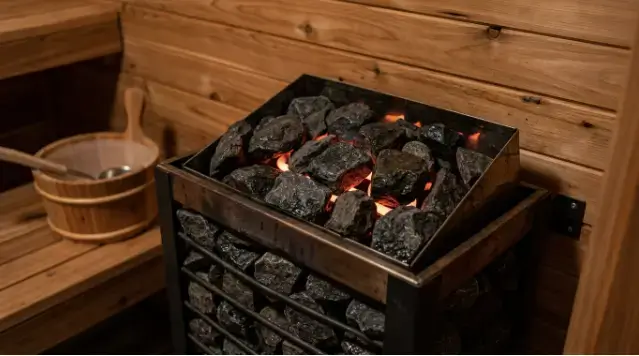
Both cedar and heat-treated (thermally modified) hemlock perform well as the wood surrounding a sauna heater, as long as the manufacturer’s clearance distances are followed. Cedar costs roughly 30 to 60 percent more and brings a natural aroma and light color, while heat-treated hemlock runs cheaper, weighs less, and holds its shape better in humidity swings but has almost no scent of its own. Neither wood is a safety risk near a properly installed heater at code clearances; the choice mostly comes down to budget, smell preference, and how the wood will look over time.
How Do the Two Woods Handle Heat Near the Heater?
Wood in general is a poor heat conductor compared with metal or stone, which is exactly why it works as a sauna surface material in the first place, and both cedar and heat-treated hemlock share this basic property. Neither wood gets dangerously hot to bare skin at typical sauna surface temperatures when installed at the heater’s specified clearance, and both are rated by their suppliers for standard sauna use immediately adjacent to a heater’s guard rail. The real difference shows up over years, not in any single session: cedar’s natural oils resist moisture absorption from steam and splashed water slightly better over time, while thermally modified hemlock gains a similar moisture resistance through the heat-treatment process itself rather than through natural oil content.
What Does the Heat-Treatment Process Actually Change?
Thermally modified hemlock starts as ordinary hemlock lumber, then goes through a controlled heating process, typically well above 350 degrees Fahrenheit in a low-oxygen kiln, that alters the wood’s cell structure. This reduces the wood’s ability to absorb moisture, improves dimensional stability so boards are less likely to warp or cup near a heat source, and darkens the wood to an even, caramel-brown tone throughout, not just on the surface. The process also strips out most of the wood’s natural scent and much of its sap content, which is part of why heat-treated species are popular right around the heater and guard rail, where sap bleed from an untreated softwood could otherwise become sticky under repeated heat cycling.
Why Does Cedar Cost More for the Same Application?
Western red cedar is a slower-growing tree with a more limited regional supply than fast-growing hemlock, and cedar’s natural rot and insect resistance comes from oils built into the wood over decades of growth rather than an industrial process, both of which push the raw material cost higher. For the wall panels and bench surfaces directly around a heater, that price premium buys the aromatic quality most people associate with a traditional sauna, along with a lighter blonde color that ages to a soft silver-gray if left untreated and exposed to humidity over years. Beginners on a tighter budget sometimes use heat-treated hemlock for the bulk of the interior and reserve cedar for a smaller accent area, like the backrest boards, to get some of the scent benefit without paying cedar prices throughout the whole room.
Does Wood Choice Affect Heater Clearance Requirements?
No, clearance requirements are set by the heater manufacturer based on the appliance’s heat output and guard rail design, not by which softwood species is used on the surrounding walls and benches. A heater rated for 3 inches of side clearance to a combustible wall needs that same 3 inches whether the wall is cedar, heat-treated hemlock, or any other standard sauna-grade softwood, since the rating assumes typical wood combustibility rather than a specific species. Buyers comparing heater models and their published clearance specs before finalizing a wood choice for the walls around the unit can check the team at SweatDecks alongside other retailers, since matching the wood plan to the exact heater’s clearance numbers avoids a layout change after materials are already purchased.
See also: Epithalon and the Telomere Question: The Mechanism Checks Out, the Human Benefit Doesn’t (Yet)
Which Wood Shows Wear Faster Near the Heat Source?
Wood closest to the heater and guard rail takes the most direct heat cycling and occasional water splash from ladling the stones, and both cedar and heat-treated hemlock will darken or show minor surface texture change in this zone faster than wood farther from the heat source. Cedar’s natural oils tend to mask minor discoloration reasonably well, while heat-treated hemlock’s already-dark, even tone can make new marks slightly more visible against the uniform background color. Neither issue affects structural integrity, and both are cosmetic changes that come with normal sauna use over years rather than signs of a problem.
Which Wood Should a Beginner Choose?
For a first sauna build on a moderate budget, heat-treated hemlock throughout, sourced from a supplier who can document the treatment process and moisture content, is a reasonable default that keeps cost down without sacrificing durability around the heater. Anyone who specifically wants the traditional cedar scent should budget the extra cost for at least the upper wall boards and backrests nearest face level, where the aroma matters most during a session, even if the lower bench and heater-adjacent panels use the more affordable heat-treated option.
What Should a Buyer Ask a Supplier Before Ordering Either Wood?
Ask for the moisture content the boards were kiln-dried or heat-treated to, since sauna-grade lumber should generally sit in the 6 to 8 percent range before installation, well below typical construction-grade framing lumber. Boards installed too wet will shrink and gap once the heater starts cycling regularly, which shows up within the first season as visible seams between boards near the heater. For heat-treated hemlock specifically, ask which temperature range the treatment process used, since suppliers using a lower-end treatment sometimes market boards as thermally modified without achieving the full moisture-resistance benefit of a properly done process. A reputable supplier of either species should have this information on hand without hesitation.
Does Sustainability Factor Into the Choice?
Heat-treated hemlock generally has a smaller environmental footprint per board than old-growth or slow-rotation cedar, since hemlock is faster growing and more commonly available from managed regional forestry operations, and the heat-treatment process itself uses only heat and steam rather than chemical preservatives. Cedar sourced from a certified sustainable forestry program is a reasonable middle ground for buyers who want the scent but still care about sourcing, and checking for a forestry certification label on either species is worth the extra minute at checkout for anyone weighing this as part of the decision.
Frequently Asked Questions
Is cedar or heat-treated hemlock better near a sauna heater?
Both hold up fine at standard clearances. Cedar brings natural aroma and costs more, while heat-treated hemlock is lighter, more affordable, and dimensionally stable but has almost no scent.
Does heat-treated hemlock get hotter to the touch than cedar?
No, the two woods conduct heat similarly at typical sauna surface temperatures, so neither feels reliably hotter on a bench.
Why is cedar more expensive than heat-treated hemlock?
Cedar is a slower-growing species with natural rot resistance and limited regional supply, while hemlock is faster-growing and gains its rot resistance through an industrial heat-treatment process instead.
Does the wood near the heater need to be replaced more often than other bench wood?
It can show cosmetic wear slightly sooner, since it takes the most heat cycling and occasional water splash, regardless of which species is used.
References
- Cardiovascular and Other Health Benefits of Sauna Bathing: A Review of the Evidence, Mayo Clinic Proceedings, 2018
- Benefits and risks of sauna bathing, The American Journal of Medicine, 2001
- Does the Combination of Finnish Sauna Bathing and Other Lifestyle Factors Confer Additional Health Benefits? A Review of the Evidence, Mayo Clinic Proceedings, 2023
By Elena Marsh